Duke of Monmouth on the Run July 1685
Destination Poole, Dorset ?

After the Battle of Sedgemoor debacle on 6th July 1685, the Duke of Monmouth and Lord Grey went on the run.They were caught separately on 8th July 1685. But where were they heading? Historian and specialist on the Monmouth Rebellion Peter Earle favoured Poole as Monmouth and Lord Grey's destination,and the hope of a ship out of England. EARLE Battle of Sedgemoor historian John Tincey shares this view TINCEY along with biographer Laura Brennan. BRENNAN 2018 Another biographer, Anna Keay, suggested that Monmouth and Lord Grey were both heading towards sympathisers living in Sussex, possibly to Lord Grey's estates KEAY 2016. The latter seems less likely as the authorities were bound to search any house or land connnected to Lord Grey, but on the other hand Monouth had successfully cultivated support in Chichester and had been regularly fox hunting in the surrounding district from 1679-1683. KEAY 2020
The ships that conveyed Monmouth and his supporters from the Dutch Republic, moored outside Lyme Regis, had been impounded by the Royal Navy. Certainly Monmouth was heading south east towards Poole, a port then on the eastern edge of Dorset ( before county boundary changes). But he was captured further east at Verwood, towards the New Forest, so had bypassed the town by about 13 miles. Monmouth may have simply got lost or wanted to hide in the Forest and head for Poole later.
Probably only a few citizens of Poole joined the Monmouth Rebellion-records aren't clear. Upon hearing of Monmouth landing at Lyme, the Dorset militia soon mobilised and kept their loyalty to the Crown, preventing potential supporters from heading west. Poole -just as Lyme Regis- had supported Parliament during the Civil Wars and the two towns, at opposite sides of Dorset, were never taken by the Royalists. There might be sympathisers in Poole, or at least people who if they recognised the Duke on the run, would look the other way.Also, as the largest port of Dorset, a stranger in the town would not necessarily attract notice. In fact Monmouth on his own in the countryside was soon identified.
The disadvantage of Poole was that firstly the authorities might also consider the town as a possible destination for Monmouth to aim for. Secondly, the town was quite easy to seal off. Built on a peninsula, the road leading into Poole flooded regularly.VINE Up until the Civil Wars, there was a defensive wall and a town gate which could be closed, VINE though these fortifications might have changed during the reign of Charles II. Poole harbour is the second largest in the world. Its entrance is now quite narrow as changes to the Channel tides have built up sands, but would have been wider in the past and less easy for a Royal Navy ship to blockade.
It is not quite clear where the unfortunate duke was heading if he was returning to exile. He was banned from the Dutch Republic by Stadtholder William, (our future William III) who did not wish to quarrel with his father in law James II. Yet Monmouth had sympathisers there, particularly in Amsterdam.It is also possible that William might ignore Monmouth's presence as long as he led a quiet existence in Dutch territory, and didn't get anywhere near Court. Catholic France would not be a safe sanctuary with Louis XIV launching his own persecution of Protestants. Perhaps Monmouth was hoping to somehow journey by small boat or yacht from Poole to another part of Britain.
On 21st September 1685 11 of the Monmouth rebels were executed at Poole, part of the Bloody Assizes presided by Judge Jeffries. WARWALKS The authorities were keen to stagger the trials and executions across a wider area than that covered by the Rebellion The rebels who were put to death in Poole were :
William Dillany, serge weaver of Honiton, in Monmouth’s Army
Andrew Ellis (alias Cossins), of Thorncombe, in Monmouth’s Army
William Hardiman, yeoman of Thorncombe, in Monmouth’s Army
Nicholas Hoare, tanner of Colyton, in Monmouth’s Army
Thomas Jenkins, in Monmouth’s Army
William Martin, potter of Honiton, in Monmouth’s Army
John Pulling, in Monmouth’s Army
Joseph Restorick, husbandman of Colyton, in Monmouth’s Army
Robert Salter, serge weaver of Upottery, in Monmouth’s Army
Andrew Tozer, in Monmouth’s Army
Samuel Waldron, of Sidbury, in Monmouth’s Army
( Information from 'War Walks' )
Picture Credit
1873 illustration of Monmouth's capture : In the Public Domain courtesy of Wikipedia UK
Sources
Books
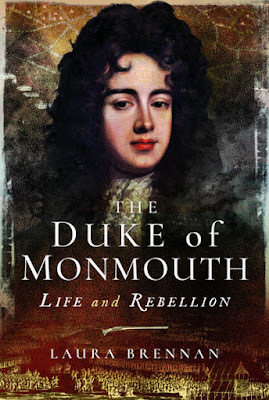
The Duke of Monmouth Life and Rebellion, Laura BRENNAN, Pen & Sword, 2018
James II and VII Britain's Last Catholic King Laura BRENNAN, Pen & Sword, 2023
Monmouth's Rebels-The Road to Sedgemoor 1685, Peter EARLE, Weidenfeld & Nicolson, 1977
The Last Royal Rebel- The Life and Death of James Duke of Monmouth ,Anna KEAY, Bloomsbury, 2017
Sedgemoor 1685 Marlborough's first victory John TINCEY, Pen & Sword, 2005
The Crabchurch Conspiracy- The True Story of Dorset's Bloodiest Secrets, Mark VINE, Sherrens Prington Ltd. Weymouth 2013
Others
Monmouth Rebels Executed at Poole 21st September 1685 , from 'War Walks' website
Poole Museum Society Blog Miscarriage and Disorder -Poole in the 1680s
The Rebel and the Fox Youtube Video about the Duke of Monmouth with an emphasis on the West Sussex connection presented by Anna KEAY from 2020. ( Last accessed 13th November 2026)
Other Blogs by Michael Bully
A Burnt Ship 17th century history & literature
Bleak Chesney Wold 19th century history & literature
World War 2 Poetry As it says on the tin
Social Media
Michael Bully @bleakchesneywold.bsky.social
Mr Bleak (@MrBleak5 )


Comments
Post a Comment